Taxonomy
- Ray-finned Fishes (Actinopterygii)
- Slickheads and tubeshoulders (Alepocephaliformes)
- Slickheads (Alepocephalidae)
- (Leptochilichthys)
- Vaillant’s Smoothhead (Leptochilichthys pinguis)
- (Leptochilichthys)
- Slickheads (Alepocephalidae)
- Slickheads and tubeshoulders (Alepocephaliformes)
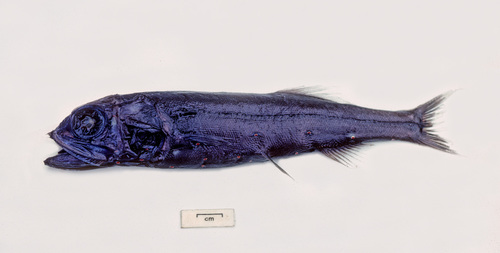
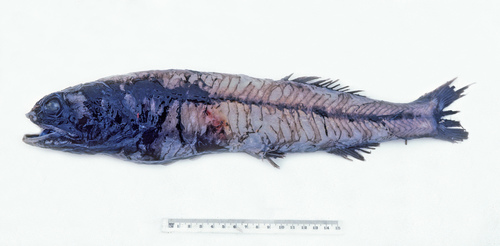
Vaillant’s Smoothhead (Leptochilichthys pinguis)
Vaillant’s Smoothhead (Leptochilichthys pinguis) is a fascinating member of the opah family commonly found in deep sea environments. Renowned for its unique adaptations and behaviors, this fish is a true marvel of marine evolution. For those curious about the mysteries of the deep sea, let’s dive into an engaging exploration of this species.
Overview
Belonging to the family Opah, Vaillant’s Smoothhead is a peculiar fish that has adapted to life in the frigid depths of the ocean. This species is predominantly found in deep, cold waters, often living at depths of 200 to 1,500 meters (656 to 4,921 feet). As a deep-sea fish, it plays a vital role in the marine ecosystem, contributing to nutrient cycles and serving as prey for various larger species.
Identification Tips:
– Body shape is elongated and streamlined. – Distinctive smooth, robust head without pronounced bony ridges. – Large eyes positioned high on the head. – Pelvic fins are notably large and located far forward. – Coloration typically dark brown to gray with lighter underbelly. – Presence of small, closely spaced scales. – Found in deep waters of the Atlantic Ocean, especially around the Mid-Atlantic Ridge.
Etymology
The scientific name, Leptochilichthys pinguis, showcases its unique classification. The genus name “Leptochilichthys” comes from Greek, where “leptos” means thin, and “chilos” means lip, referring to its fine lip structure. “Pinguis,” which means fat or plump in Latin, highlights the species’ physical form, often characterized by a stocky body that seems to be quite robust in comparison to other fish.
Physical Characteristics
Vaillant’s Smoothhead can grow up to 30 centimeters (approximately 12 inches) in length. Its body is predominantly characterized by an elongated form and a relatively large head, which contributes to its unique appeal. The smooth, shiny skin is often a light to dark brown color, providing camouflage against the ocean floor, while the absence of traditional scales creates a smooth texture aiding in hydrodynamics. The fish possesses large eyes adapted for the low-light conditions of the deep sea, allowing it to spot prey with remarkable efficiency.
Identifiable Traits
Identifying Vaillant’s Smoothhead is relatively straightforward thanks to its primary characteristics. Here are a few identifiable traits:
- Head shape: The large, rounded head gives it a distinct, blunt appearance.
- Body shape: The thick, robust body is particularly significant; it is broader at the midsection and tapers towards the tail.
- Eyes: The pronounced, large eyes are notable, adapted to the dimly lit environments.
- Coloration: A smooth body surface featuring subtle color gradients adds to its adaptability within the ocean.
- Fins: The dorsal and anal fins are long and set low on the body, providing stability as it swims through the depths.
Ecological Significance
Vaillant’s Smoothhead plays a crucial ecological role in the deep-sea environment. As a benthic feeder, it primarily consumes crustaceans and small fish, contributing to the control of prey populations. Through its feeding habits, this species also facilitates the recycling of nutrients within the ecosystem, making it an integral part of the food web. The dynamics between Vaillant’s Smoothhead and its prey help maintain balanced populations of various marine organisms, thus promoting biodiversity.
Location/Region
This species is predominantly found in the Southern Hemisphere. Its habitat ranges from the deeper offshore regions of the Atlantic, Indian, and Pacific Oceans, mainly along the continental shelves and slopes. Although not heavily studied, specific areas noted for sightings include the waters surrounding South Africa, Australia, and New Zealand.
Social Behavior
Vaillant’s Smoothhead is known as a solitary fish. It tends to inhabit the ocean floor, finding shelter in crevices and among rocks. While not typically social, studies suggest that these fish can occasionally be found in loose aggregations, especially during feeding times or in suitable habitats. Their solitary behavior, coupled with their unique adaptations, allows them to maximize energy usage in a resource-scarce environment.
Mating Practices
The mating habits of Vaillant’s Smoothhead are not well-documented, as is the case with many deep-sea species. However, like other fish, they are believed to spawn in open waters, where females release eggs that males fertilize. The environmental conditions in their deep-sea habitats likely play a significant role in their reproductive success, promoting the survival of the species despite the extreme conditions.
Natural Predators
In the vast depths of the ocean, Vaillant’s Smoothhead faces predation from larger fish, such as deep-sea sharks and other predatory fish species. Their adaptations, including coloration and deep-water habitat, help mitigate the risk of becoming prey, but they remain an important food source within the food web.
Conservation Status
Currently, there are no specific conservation assessments available for Vaillant’s Smoothhead. Nonetheless, its ecological role suggests that any significant changes in its population could have ramifications in the delicate balance of deep-sea ecosystems. Conservation efforts aimed at preserving deep-sea environments can indirectly support this species’ habitat.
Human Impact
Deep-sea fishing and habitat destruction due to trawling practices pose significant threats to species like Vaillant’s Smoothhead. Pollution, climate change, and ocean acidification further complicate their survival. Effective management strategies are essential to mitigate these impacts and ensure the longevity of both the species and its delicate habitat.
Interesting Facts
Here are a few interesting tidbits about Vaillant’s Smoothhead that might surprise you:
- Due to the depths they inhabit, much of Vaillant’s Smoothhead behavior remains a mystery, highlighting the vast knowledge still to uncover about deep-sea ecosystems.
- They are part of a remarkable array of adaptations that facilitate existence in extreme environments, showcasing nature’s ingenuity.
- Seeing Vaillant’s Smoothhead in the wild is exceptionally rare, making it a sought-after sight for marine biologists and enthusiasts alike.
With its unique adaptations and important ecological role, Vaillant’s Smoothhead (Leptochilichthys pinguis) is more than just a fascinating fish; it is a testament to the incredible diversity and resilience of life in our oceans. As we continue to learn more about these deep-sea dwellers, it becomes increasingly important to protect their habitats and ensure their survival for future generations.
Vaillant’s Smoothhead (Leptochilichthys pinguis)
ID: 529360